


Last updated: 2026-10
The simplest way to take supplements without water is to use a format that dissolves in the mouth: an oral dissolvable strip dissolves on the tongue in 7 to 30 seconds, using saliva alone. Because it is a solid, it also travels without the liquid limits that apply to shots, sprays and drinkable formats at airport security.
Smart Strips are made for exactly these moments. Each strip comes in its own sealed sachet, light and compact, so a few of them go anywhere with you: a jacket pocket, a handbag, a carry-on. This guide covers the situations where water is the problem, from the airport queue to the meeting that runs over, and what to pack for each.
Why is water the weak point of most supplement routines?
Most supplements assume a glass of water within reach. Capsules and tablets need it to be swallowed, powders need it to be mixed, and effervescent tablets need a full glass and a few minutes. At home that is easy. Away from home it becomes the step that gets skipped.
Think about an ordinary travel day. You leave the house at 5:40 for a 7:15 flight. Your water bottle is confiscated at security, the café queue is long, and by the time you have a drink you are boarding. The vitamins stayed in the bathroom cabinet or the bottom of the suitcase. Repeat that for three days and the routine is gone.
A format that needs nothing but your mouth removes that step. It also changes where supplements can live: in a jacket pocket, a handbag, a laptop sleeve, a gym bag. For more on why skipped doses matter more than most people think, read why your supplements aren’t working.
Can you take supplements through airport security?
In the United States, yes. TSA states that “you can bring your medication in pill or solid form in unlimited amounts as long as it is screened”, in both carry-on and checked baggage, and it does not require medication to be in prescription bottles (TSA, Can you pack your meds in a pill case and more questions answered). For supplements specifically, the TSA “What Can I Bring?” list shows vitamins as permitted in both carry-on and checked baggage, and the final decision rests with the security officer at the checkpoint.
A few practical points from the same TSA guidance:
- Carry-on is better. TSA “highly recommended you place these items in your carry-on” so you have them when you need them.
- X-ray is standard. Medication “is usually screened by X-ray”. If you prefer a visual inspection, ask for it before your items go into the X-ray tunnel.
- Liquids are different. TSA lists liquid vitamins for carry-on at up to 3.4 oz (100 ml), the usual liquid limit. A strip is a solid, so this limit does not apply to it.
In the EU, liquids in cabin baggage must be in containers of no more than 100 ml inside a transparent bag of up to one litre, while medicines are exempt from the volume limit (Your Europe, European Commission). These are rules for liquids, and a strip is a solid. The details can depend on the screening equipment at each airport, so check before you fly. Keep supplements in their original sachets with the label visible. It makes any question at the checkpoint shorter, and some countries have their own rules on what you bring in, so check before an international trip.
Why are oral strips considered TSA friendly supplements?
They are solid, individually sealed and labelled, and they need no liquid to take. A box of 30 strips holds 30 sachets; for a trip you can take out the number of days you need and leave the box at home. The sachets themselves are light and compact and slip into a carry-on or a jacket pocket, so they go through the X-ray with everything else you already carry. The box takes up more room, which is the reason to travel with the sachets only.
How to take supplements on a plane
Take the strip with a clean mouth and dry fingers, let it dissolve fully, and avoid drinking for a few minutes afterwards. That is the same method as on the ground, with a few details that matter at altitude.
Cabin air is dry. Measurements on commercial flights show average cabin humidity of around 10 percent at altitude (National Academies, 2026), and the Aerospace Medical Association notes that low humidity can cause dry skin and eye irritation in sensitive travellers. A strip dissolves in saliva, so if you have not drunk anything for a while and your mouth feels dry, a sip of water a minute or two before the strip helps, and the strip still dissolves in 7 to 30 seconds. Dry fingers matter more than usual on a plane, where hands are often cold or damp from a drink: a pullulan strip starts dissolving the moment it touches moisture.
Timing is the other half. A few anchors for a long-haul flight:
- To rest on board or after landing. Z-z-Zen contains 1 mg of melatonin with saffron, glycine and L-theanine. Melatonin contributes to the reduction of time taken to fall asleep; the beneficial effect is obtained with 1 mg close to bedtime. Melatonin contributes to the alleviation of subjective feelings of jet lag; here the effect is obtained with at least 0.5 mg taken close to bedtime on the first day of travel and on the following few days after arrival. On a trip, “bedtime” means the time you intend to sleep at your destination, which is also how the studies were run: a Cochrane review found that melatonin taken close to the target bedtime at the destination reduced subjective jet lag in most of the trials it included (Herxheimer and Petrie, 2002). Do not take it before you have to drive.
- To stay sharp after landing. FOCUS carries 20 mg of caffeine with L-theanine, Alpha-GPC and citicoline. That is a small amount of caffeine by design, useful for the meeting after the flight, not for the night before.
- To keep the daily habit going. IMMUNE contains vitamin C and vitamin D3. Vitamin C contributes to the normal function of the immune system. Vitamin D contributes to the normal function of the immune system. Travel is when this kind of habit tends to lapse.
These three strips together are our Travel Pack: Z-z-Zen, FOCUS and IMMUNE in one set. If you are pregnant, nursing, taking medication or have a medical condition, consult your doctor before using supplements while travelling.
Supplements at the office, without the desk drawer pharmacy
At work, the problem is not the lack of water. It is that taking capsules at a desk feels like a small public event, and a drawer full of bottles is easy to stop opening.
A sachet in your jacket pocket changes that. Take a FOCUS strip before the afternoon block of work that needs attention, the time a lot of people reach for a third coffee. Tear, place, and it dissolves on the tongue within seconds, before the meeting has finished loading. The gesture itself is what we call the 7-second ritual: taking the strip out and placing it on the tongue.
For a full working day, Work & Perform pairs FOCUS with FCKN FIT, one strip for the desk and one for training after hours.
Supplements before training, with no shaker
Pre-workout powders need a shaker, a measured scoop and water, and the shaker usually stays in the gym bag longer than it should. An oral strip goes into a pocket of the gym bag in its sachet.
FCKN FIT is taken 15 to 30 minutes before training. Each strip contains 30 mg of L-carnitine, 20 mg of caffeine, 10 mg of niacin, 5 mg of GBBgo, 5 mg of tamarind extract and 100 µg of chromium. Niacin contributes to the reduction of tiredness and fatigue, and chromium contributes to normal macronutrient metabolism. Twenty milligrams of caffeine is a modest dose: according to the European Food Safety Authority, a 60 ml espresso contains about 80 mg of caffeine and a 200 ml cup of filter coffee about 90 mg (EFSA, 2015). That makes a strip roughly a quarter of an espresso, which suits people who train after work and still want a normal night. Caffeine itself is absorbed quickly: swallowed in solution, it reached peak blood levels in about half an hour in a classic study in healthy men (Blanchard and Sawers, 1983).
Training outdoors, or on the way back from the office, is where a no-water format earns its place. You still need to drink during exercise; the strip simply does not add another reason to.
What if swallowing pills is hard for you?
If capsules and tablets are difficult to swallow, a format that dissolves in the mouth removes that step altogether. Difficulty swallowing tablets is more common than most people assume. In a general practice population in Germany, 27% of patients reported it (Schiele et al., 2013, as cited by Messerli et al., 2017), and a systematic review found that “approximately 14 % of community-dwelling older patients experience difficulty swallowing medicines” (Mc Gillicuddy et al., 2016). Many people with no medical condition at all simply dislike large capsules.
An oral dissolvable strip is a thin film that turns into liquid on the tongue in 7 to 30 seconds. There is nothing to chew and nothing large to swallow. It is not a medical device, and it does not replace advice for people who have a diagnosed swallowing condition. If swallowing is difficult because of a medical condition, speak to your doctor or a speech and language therapist about which formats are safe for you.
For more on how much of a strip is absorbed in the mouth and how much is swallowed with saliva, see sublingual vs swallowed supplements.
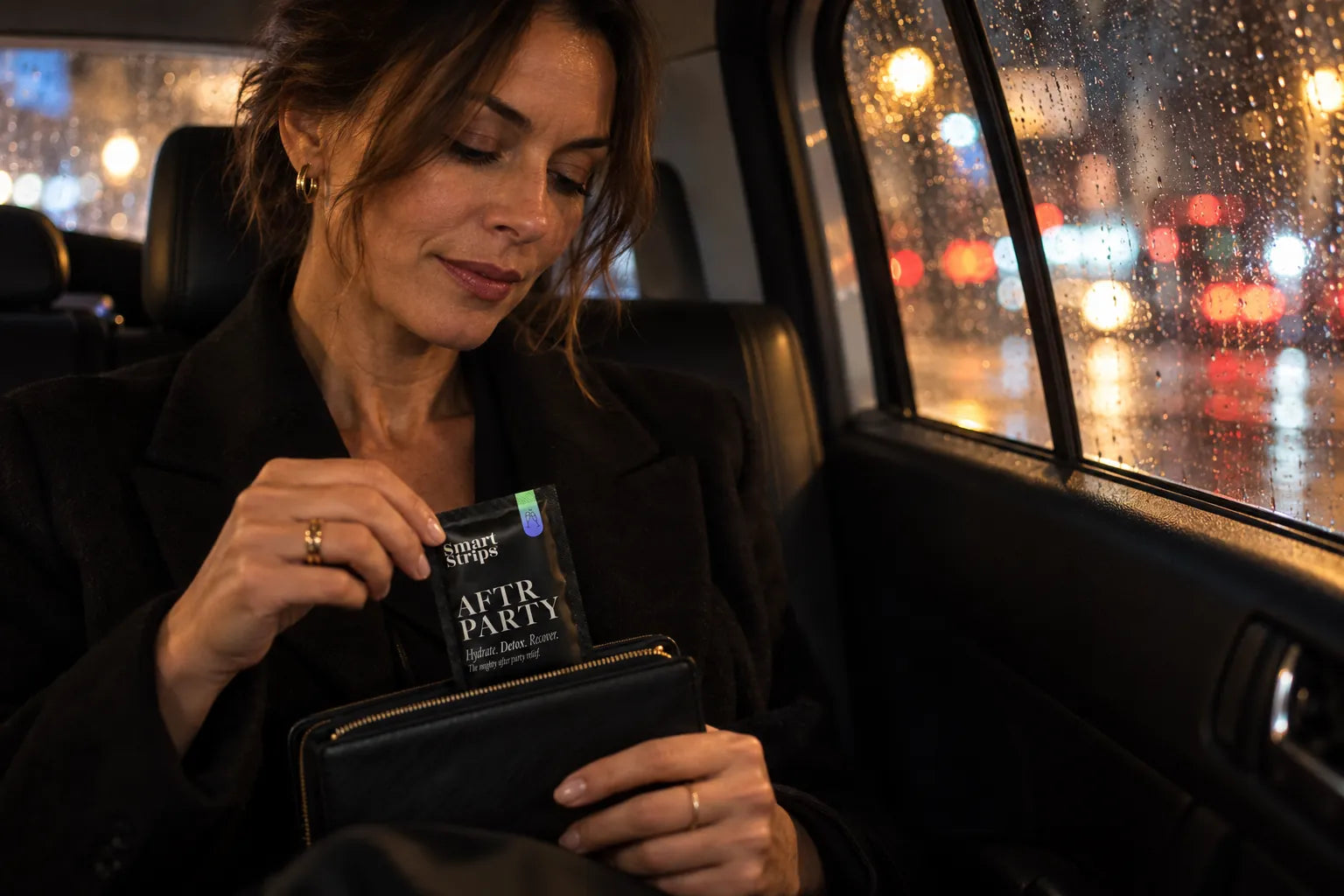
How to pack supplements for a trip
Pack by day, not by bottle. Count the days, count the strips you take each day, add one or two for delays, and take only those sachets with you.
- Daily habits first. One IMMUNE sachet per day goes into your pocket or bag.
- Evenings second. One Z-z-Zen per night goes into the toiletry bag, next to the toothbrush, where you will see it before bed.
- Work and training third. FOCUS and FCKN FIT go wherever you will be when you need them: the laptop bag, the gym bag.
- Keep sachets dry and away from heat. Leave them out of a hot car or a sunny window sill, and do not open a sachet until the moment you take it.
- Keep the label with you. The sachets are labelled; a photo of the box label on your phone answers most questions at a border.
If you want to understand the format before your first trip, start with what oral dissolvable strips are, or compare them directly in oral strips vs pills, capsules and gummies.
For your next trip, the Travel Pack covers the evening, the working day and the daily habit, in sachets that fit where your boarding pass goes.
FAQ
How can I take supplements without water?
Use a format that dissolves in the mouth. Oral dissolvable strips dissolve on the tongue in 7 to 30 seconds using saliva alone.
Are oral strips allowed in carry-on luggage?
In the US, TSA lists vitamins as permitted in carry-on and checked bags, and allows medication in pill or solid form “in unlimited amounts as long as it is screened”. The final decision rests with the officer at the checkpoint. Strips are solid and individually sealed. Check local rules for international destinations.
Do I need to keep supplements in their original packaging when flying?
TSA “does not require passengers to have medications in prescription bottles”. Keeping sachets labelled makes screening and border questions easier.
Can I take an oral strip during a flight?
Yes. Use dry fingers, let it dissolve fully, and wait a few minutes before drinking. If your mouth is very dry, a sip of water a minute or two beforehand helps.
Which Smart Strips are in the Travel Pack?
Z-z-Zen for the evening, FOCUS for the working day and IMMUNE for the daily habit.
Are Smart Strips easy to carry?
Yes. Each strip is individually sealed in a light, compact sachet that goes in a pocket, a handbag or a gym bag. For travel, take the sachets you need and leave the box at home.
Are oral strips suitable if I have trouble swallowing pills?
There is nothing to swallow whole, which suits many people who dislike capsules. If you have a diagnosed swallowing condition, ask your doctor which formats are safe for you.
Do I need to drink after taking a strip?
No. Wait a few minutes before drinking, so less of the dissolved strip is washed into the stomach.
Sources
- Transportation Security Administration. Can you pack your meds in a pill case and more questions answered. tsa.gov, accessed 7 October 2026. https://tsa.gov/travel/travel-tips/can-you-pack-your-meds-pill-case-and-more-questions-answered
- Transportation Security Administration. What Can I Bring? Medical: Vitamins; Liquid Vitamins. https://tsa.gov/travel/security-screening/whatcanibring/medical?page=3
- European Commission, Your Europe. Luggage restrictions. https://europa.eu/youreurope/citizens/travel/carry/luggage-restrictions/index_en.htm
- European Commission, DG MOVE. Commission enforces temporary restrictions on liquid screening at certain EU airports. News, 31 July 2024. https://transport.ec.europa.eu/news-events/news/commission-enforces-temporary-restrictions-liquid-screening-certain-eu-airports-2024-07-31_en
- National Academies of Sciences, Engineering, and Medicine. Health and Safety Impacts of Aircraft Cabin Temperatures. 2026. Appendix B, Table B-1. https://www.nationalacademies.org/read/29472/chapter/10
- Aerospace Medical Association. Health Tips for Airline Travel. 2013. https://asma.org/asma/media/asma/Travel-Publications/HEALTH-TIPS-FOR-AIRLINE-TRAVEL-Trifold-2013.pdf
- Commission Regulation (EU) No 432/2012 establishing a list of permitted health claims made on foods. Annex (melatonin, vitamin C, vitamin D, niacin, chromium). https://www.legislation.gov.uk/eur/2012/432/annex; Bulgarian text: https://eur-lex.europa.eu/legal-content/BG/TXT/HTML/?uri=CELEX:32012R0432
- Herxheimer A, Petrie KJ. Melatonin for the prevention and treatment of jet lag. Cochrane Database Syst Rev. 2002;(2):CD001520. DOI 10.1002/14651858.CD001520
- EFSA Panel on Dietetic Products, Nutrition and Allergies (NDA). Scientific opinion on the safety of caffeine. EFSA Journal. 2015;13(5):4102. DOI 10.2903/j.efsa.2015.4102. Serving values via EUFIC: https://eufic.org/en/whats-in-food/article/efsa-opinion-on-the-safety-of-caffeine
- Blanchard J, Sawers SJA. The absolute bioavailability of caffeine in man. Eur J Clin Pharmacol. 1983;24(1):93-98. DOI 10.1007/BF00613933
- Schiele JT, Quinzler R, Klimm HD, Pruszydlo MG, Haefeli WE. Difficulties swallowing solid oral dosage forms in a general practice population: prevalence, causes, and relationship to dosage forms. Eur J Clin Pharmacol. 2013;69(4):937-948. DOI 10.1007/s00228-012-1417-0. Figure as cited in: Messerli M, et al. Patient Prefer Adherence. 2017;11:1687-1699. DOI 10.2147/PPA.S142653
- Mc Gillicuddy A, Crean AM, Sahm LJ. Older adults with difficulty swallowing oral medicines: a systematic review of the literature. Eur J Clin Pharmacol. 2016;72(2):141-151. DOI 10.1007/s00228-015-1979-8


