


Last updated: October 2026.
Waking up at 4am is usually a sleep-maintenance problem rather than a sleep-onset one: by that hour most of the night’s deep sleep is behind you and REM periods are getting longer, so a small trigger is enough to bring you fully awake. Evening alcohol, caffeine after lunch, a warm bedroom and an unfinished day all make that 4am window more fragile, and most of them can be changed within a week.
This guide explains what is happening at that hour, which habits make the biggest difference, and where an oral dissolvable strip such as Smart Strips Z-z-Zen can sit inside an evening routine. It is written for the person who falls asleep without much trouble, then lies awake at 4am while the mind runs through tomorrow’s list.
Why do I wake up at 4am every night?
Most people who wake at the same hour every night are reacting to timing inside the night itself. You cycle through non-REM and REM sleep several times a night, and the first REM period arrives about 90 minutes after you fall asleep. Deep sleep comes in longer periods during the first half of the night, while REM periods grow longer towards morning (National Institute of Neurological Disorders and Stroke). By 4am, the heaviest sleep of the night is largely spent.
At the same time, your internal clock is preparing you for the day. Cortisol, the hormone that helps you get up and moving, follows a daily rhythm, and once you wake it typically rises by 38 to 75%, peaking about 30 minutes later (Elder et al., 2014). In a calm week a brief wake-up at 4am passes almost unnoticed. In a week with a deadline, a sick parent or a difficult conversation waiting, the same brief wake-up can turn into an hour of lying awake.
So 4am is less random than it feels. It is the point where the night’s deepest sleep is already behind you, and waking takes less.
Why does my mind start running through tasks?
At 4am the problems of the day arrive without their context. The email you postponed, the quarterly numbers, the meeting at ten, the call you should make to your mother. During the day you would weigh each one against everything else. In the dark, with nothing competing for attention, each item feels urgent and unsolved.
This loop feeds itself. A thought produces a small jolt of alertness, the alertness makes the next thought sharper, and twenty minutes later you are planning the whole week. Stress does not need to be dramatic to do this. A steady background of “too much to do” is enough.
Does alcohol make you wake up in the middle of the night?
Often, yes. A glass or two of wine can make it easier to fall asleep, which is why many people see it as a sleep aid. A review of research on alcohol and normal sleep found exactly that pattern: a shorter time to fall asleep, followed by more sleep disruption in the second half of the night (Ebrahim et al., 2013). The 4am wake-up after a dinner with wine is a pattern many people recognise.
If you want to test this, keep two weeks of notes: what you drank, at what time, and when you woke. Many people find their 4am nights cluster after evenings with alcohol, even moderate amounts.
What helps you stay asleep until morning
The habits below work on the second half of the night specifically. None of them is new. What changes results is doing four or five of them consistently for two weeks, instead of trying one for a night.
Get daylight in the morning and keep the evening dim
Your body clock sets itself mainly by light. Morning light moves the clock earlier and evening light pushes it later, and daylight outdoors is far brighter than any room: up to 25,000 lux in full daylight, against about 500 lux for typical office lighting (Blume et al., 2019). Time outside in the morning, even on a cloudy day, tells the clock clearly when the day begins. In the evening, the opposite helps: lower, warmer lamps after dinner and no bright overhead light in the last hour before bed.
Stop caffeine after lunch
Caffeine stays in the body for hours. In healthy adults, the body needs on average about four hours to eliminate half of the caffeine consumed, and this time ranges from two to eight hours (EFSA, 2015). A coffee at 4pm is therefore still partly in your system at bedtime. In one study, 400 mg of caffeine taken even six hours before bed reduced measured sleep time by more than one hour (Drake et al., 2013). A simple rule: no caffeine after 1pm, including tea, cola and chocolate desserts.
Keep the bedroom cool
A warm room works against the second half of the night. A review of sleep and the thermal environment found that, in real-life conditions with bedding and clothing, “heat exposure increases wakefulness and decreases slow wave sleep” (Okamoto-Mizuno and Mizuno, 2012). A heavy duvet in a warm room is one of the quiet reasons people wake up in the early hours, so aim for a bedroom that feels cool rather than a particular number on the thermostat.
Put screens away, and the phone out of reach
Screen light in the evening has a measurable effect: reading on a light-emitting device before bed suppressed melatonin and delayed sleep compared with reading a printed book (Chang et al., 2015). The content counts too. Email, news and messages in bed hand you exactly the material your brain will replay at 4am. Charge the phone outside the bedroom or at least across the room. If you wake, you will not be tempted to check the time or the inbox.
Write the list before bed
Ten minutes in the evening with a notebook can take the pressure off the night. Write down what is unfinished and the first small step for each item. The point is to give your mind proof that the task is captured somewhere. People who do this often find that the 4am list has less to say.
What to do when you are already awake at 4am
Do not look at the clock. Doing the arithmetic of “only two hours left” raises alertness. Breathe slowly with a longer exhale than inhale. If you are still awake after about twenty minutes, get up, sit somewhere dim and read something calm on paper until you feel heavy again. Lying in bed fighting for sleep teaches the brain that the bed is a place for worrying.
Where Z-z-Zen fits in
Picture a specific Tuesday. You were in bed by 11, asleep by 11:20, and at 4:10 you are wide awake, replaying a conversation with a client. You know the alarm is at 6:45. You know you will be tired at 3pm. This is the situation Smart Strips Z-z-Zen was designed around.
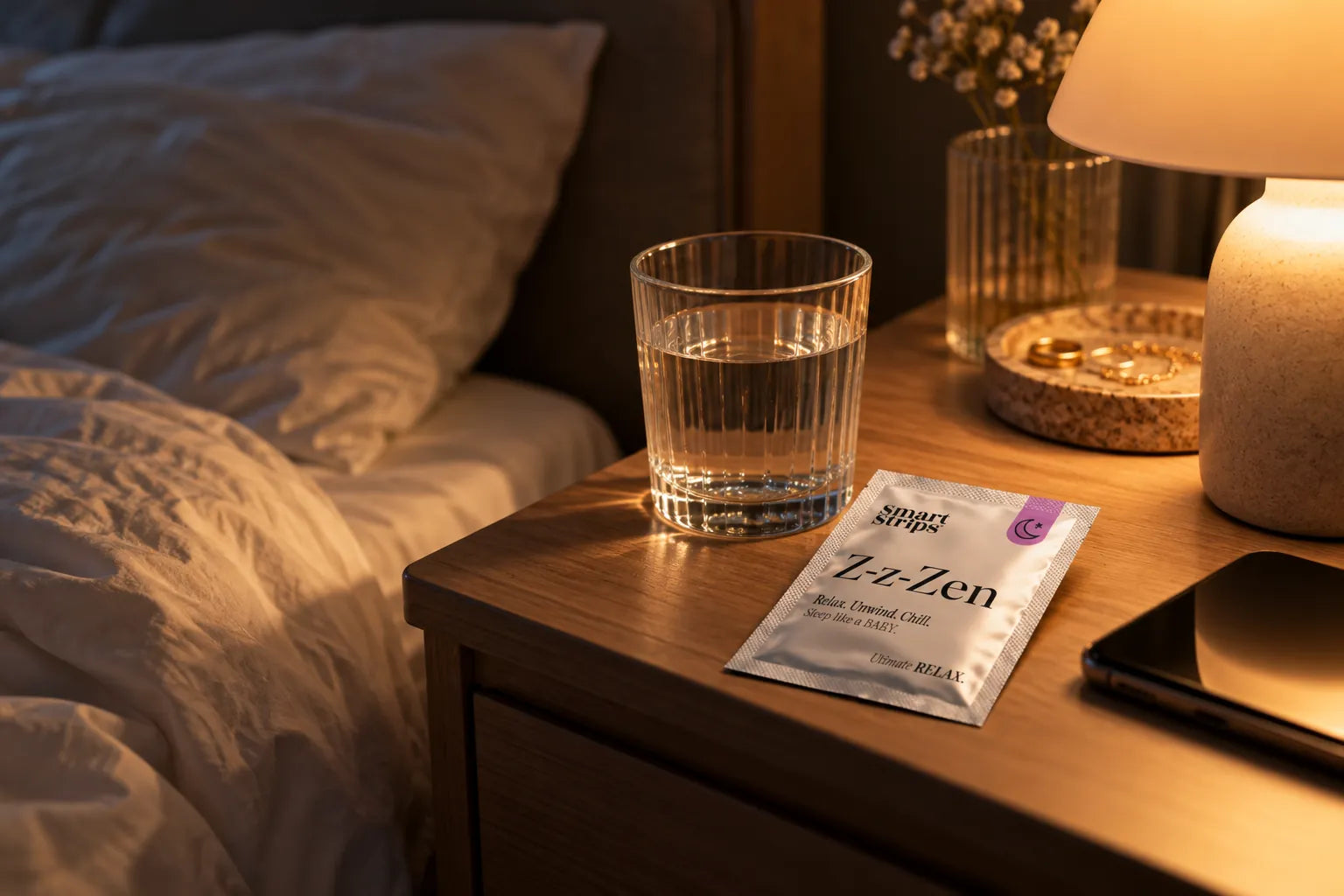
Z-z-Zen is an oral dissolvable strip you place on the tongue close to bedtime. It dissolves in 7 to 30 seconds, with no water and no capsule to swallow. Each strip contains four ingredients, and melatonin is the smallest part of the formula.
Melatonin, 1 mg. Melatonin contributes to the reduction of time taken to fall asleep. The beneficial effect is obtained by consuming 1 mg of melatonin close to bedtime. This is the approved EU wording (Regulation (EU) No 432/2012), and 1 mg is exactly the amount in each strip.
Saffron extract, 14 mg. The same amount was the lower of two doses in a randomised, placebo-controlled study that gave adults with poor sleep an evening saffron extract and followed their sleep quality (Lopresti et al., 2021).
L-Glycine, 12 mg. An amino acid that sleep research has examined before bedtime, though in gram amounts many times the quantity in one strip (Yamadera et al., 2007).
L-Theanine, 12 mg. Found naturally in tea leaves. Studies in healthy adults have used far larger daily amounts (Hidese et al., 2019); here it is one quiet part of an evening formula.
The idea behind the formula is the person in the Tuesday example: falling asleep more easily is part of it, and the other part is a night that continues through the fragile early hours. The result we built Z-z-Zen for is waking up with the alarm, instead of before it. Individual results vary, and a strip works best together with the habits above, not in place of them.
Why a strip instead of a melatonin tablet
When you swallow melatonin, a large part of it is broken down before it reaches circulation. One study measured the absolute bioavailability of swallowed melatonin at approximately 15% (DeMuro et al., 2000). The lining under your tongue is only 100 to 200 µm thick (Hua, 2019), and medicine uses it for some molecules: nitroglycerin placed under the tongue reaches peak blood levels in 6 to 7 minutes (Nitrostat prescribing information). With an oral dissolvable strip, part of the dose is absorbed through the lining of the mouth, and for that part first-pass metabolism in the liver is significantly reduced. For the format as a whole, Smart Strips uses three figures: up to 95% bioavailability, up to 4x faster absorption and up to 30% higher effectiveness.
There is also a practical side at bedtime. The sachet is 8 by 5 cm, there is no glass of water to fetch, and nothing sweet stays on the teeth after you have brushed them. You can read more about the format in What are oral dissolvable strips and see the comparison in Melatonin strips vs melatonin gummies.
If your nights are restless mainly because of daytime stress that follows you home, Smart Strips ANXIETY is formulated for calm during the day, with L-Theanine, GABA and saffron extract. Z-z-Zen stays the evening strip.
When to talk to a doctor
An occasional 4am wake-up during a stressful month is common. Speak to your doctor if you wake in the night three or more times a week for several weeks, if you snore heavily or wake up gasping, if your mood has dropped, or if daytime tiredness affects your work or your driving. Persistent insomnia has many possible causes, and some of them need a proper medical assessment.
Food supplements are not a substitute for a varied, balanced diet and a healthy lifestyle. Consult your doctor if you are pregnant, nursing, taking medication or have a medical condition, and before giving melatonin to anyone under 18.
FAQ
Why do I always wake up at exactly the same time?
Sleep follows a regular rhythm: the first REM period comes about 90 minutes after you fall asleep, the cycles repeat through the night, and deep sleep is concentrated in the first half (NINDS). If something nudges you awake once that deep sleep has passed, it tends to happen at about the same hour each night.
Is waking up at 4am a sign of a health problem?
Not necessarily. It is very often linked with stress, alcohol, caffeine or a warm room. If it continues for several weeks, or you have other symptoms, talk to your doctor.
How much melatonin is in Z-z-Zen?
1 mg per strip. Melatonin contributes to the reduction of time taken to fall asleep, and the beneficial effect is obtained by consuming 1 mg of melatonin close to bedtime.
What else is in Z-z-Zen besides melatonin?
Saffron extract 14 mg, L-Glycine 12 mg and L-Theanine 12 mg, alongside melatonin 1 mg.
How fast does a sleep strip dissolve?
A Smart Strips oral dissolvable strip dissolves on the tongue in 7 to 30 seconds, without water.
Should I take a strip when I wake at 4am?
Follow the directions on the pack. Melatonin is taken close to bedtime. If you regularly wake in the night, focus on the evening routine and speak with your doctor about what is right for you.
Can I use Z-z-Zen every night?
Follow the recommended daily dose on the pack. If you need help with sleep every night for weeks, it is worth discussing with your doctor.
Is Z-z-Zen vegan?
Yes. Z-z-Zen contains no ingredients of animal origin. The only formula in the range that is not vegan is BEAUTÉ, which contains marine collagen.
When the evening routine is in place, a strip on the tongue becomes the last step before the lights go out. Discover Z-z-Zen.
Sources
- National Institute of Neurological Disorders and Stroke (NINDS). Brain Basics: Understanding Sleep. https://www.ninds.nih.gov/health-information/public-education/brain-basics/brain-basics-understanding-sleep
- Elder GJ, Wetherell MA, Barclay NL, Ellis JG. The cortisol awakening response: applications and implications for sleep medicine. Sleep Med Rev. 2014;18(3):215-224. DOI 10.1016/j.smrv.2013.05.001
- Ebrahim IO, Shapiro CM, Williams AJ, Fenwick PB. Alcohol and sleep I: effects on normal sleep. Alcohol Clin Exp Res. 2013;37(4):539-549. DOI 10.1111/acer.12006
- Blume C, Garbazza C, Spitschan M. Effects of light on human circadian rhythms, sleep and mood. Somnologie. 2019;23(3):147-156. DOI 10.1007/s11818-019-00215-x
- European Food Safety Authority. Caffeine: EFSA explains risk assessment. 2015. https://www.efsa.europa.eu/sites/default/files/corporate_publications/files/efsaexplainscaffeine150527.pdf; underlying opinion: EFSA NDA Panel. Scientific Opinion on the safety of caffeine. EFSA Journal. 2015;13(5):4102. DOI 10.2903/j.efsa.2015.4102
- Drake C, Roehrs T, Shambroom J, Roth T. Caffeine effects on sleep taken 0, 3, or 6 hours before going to bed. J Clin Sleep Med. 2013;9(11):1195-1200. DOI 10.5664/jcsm.3170
- Okamoto-Mizuno K, Mizuno K. Effects of thermal environment on sleep and circadian rhythm. J Physiol Anthropol. 2012;31:14. DOI 10.1186/1880-6805-31-14
- Chang AM, Aeschbach D, Duffy JF, Czeisler CA. Evening use of light-emitting eReaders negatively affects sleep, circadian timing, and next-morning alertness. Proc Natl Acad Sci U S A. 2015;112(4):1232-1237. DOI 10.1073/pnas.1418490112
- Commission Regulation (EU) No 432/2012 establishing a list of permitted health claims made on foods, Annex (melatonin entries). https://www.legislation.gov.uk/eur/2012/432/annex; Bulgarian text: https://eur-lex.europa.eu/legal-content/BG/TXT/HTML/?uri=CELEX:32012R0432
- Lopresti AL, Smith SJ, Drummond PD. An investigation into an evening intake of a saffron extract (affron) on sleep quality, cortisol, and melatonin concentrations in adults with poor sleep: a randomised, double-blind, placebo-controlled, multi-dose study. Sleep Med. 2021;86:7-18. DOI 10.1016/j.sleep.2021.08.001
- Yamadera W, Inagawa K, Chiba S, et al. Glycine ingestion improves subjective sleep quality in human volunteers, correlating with polysomnographic changes. Sleep Biol Rhythms. 2007;5:126-131. DOI 10.1111/j.1479-8425.2007.00262.x
- Hidese S, Ogawa S, Ota M, Ishida I, Yasukawa Z, Ozeki M, Kunugi H. Effects of L-theanine administration on stress-related symptoms and cognitive functions in healthy adults: a randomized controlled trial. Nutrients. 2019;11(10):2362. DOI 10.3390/nu11102362
- DeMuro RL, Nafziger AN, Blask DE, Menhinick AM, Bertino JS. The absolute bioavailability of oral melatonin. J Clin Pharmacol. 2000;40(7):781-784. DOI 10.1177/00912700022009422
- Hua S. Advances in nanoparticulate drug delivery approaches for sublingual and buccal administration. Front Pharmacol. 2019;10:1328. DOI 10.3389/fphar.2019.01328
- NITROSTAT (nitroglycerin sublingual tablets), US Prescribing Information, clinical pharmacology. https://medlibrary.org/lib/rx/meds/nitrostat-5/page/2/


